Artificial Intelligence (AI) has become a transformative force in healthcare, offering new ways to analyze data, diagnose diseases, and personalize treatments. Among the various AI techniques, Generative AI stands out for its ability to create new data rather than simply analyzing existing datasets. In the context of healthcare, an Enterprise Generative AI Platform represents a comprehensive solution tailored to the unique needs and challenges of healthcare organizations. This article explores the key features of such a platform, highlighting its potential to revolutionize patient care, improve operational efficiency, and drive innovation in the healthcare industry.
Introduction to Enterprise Generative AI in Healthcare
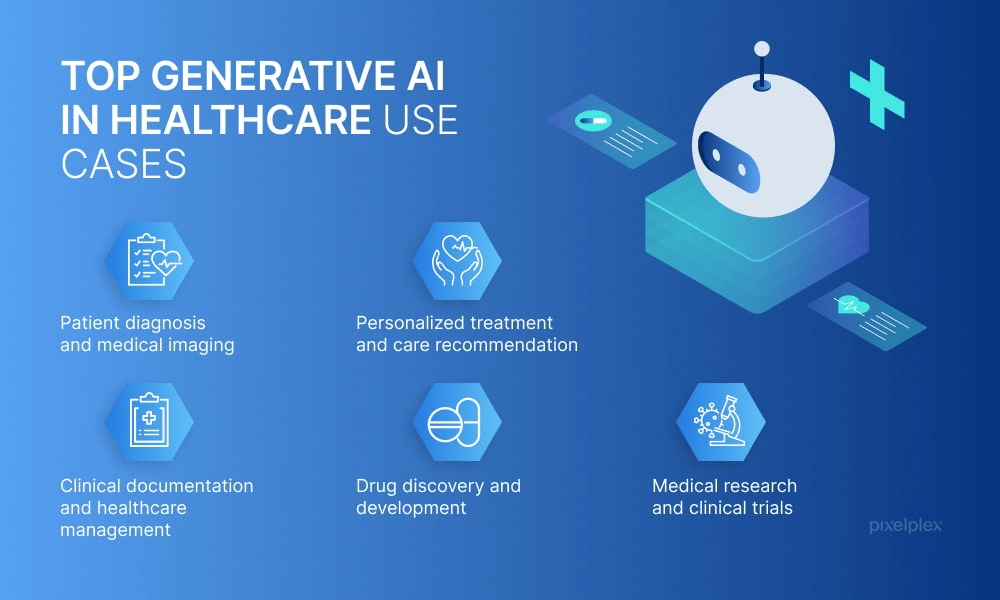
Generative AI refers to a subset of artificial intelligence technologies that focus on creating new data, such as images, texts, or even entire datasets. In healthcare, generative AI holds immense promise across various applications including medical imaging, drug discovery, personalized treatment planning, and patient data analysis.
An Enterprise Generative AI Platform for healthcare is designed to integrate advanced generative AI algorithms with robust infrastructure, data management capabilities, and security measures to deliver comprehensive solutions for healthcare organizations. Let’s delve into the key features that characterize such a platform:
1. Data Integration and Management
Central to the functionality of an Enterprise Generative AI Platform is its capability to integrate and manage vast amounts of healthcare data. This includes electronic health records (EHRs), medical imaging files, genomic data, clinical trial data, and more. The platform should provide tools for data ingestion, preprocessing, and integration to ensure interoperability and standardization across disparate data sources.
Features:
- Data ingestion pipelines for collecting data from various sources.
- Data preprocessing tools for cleaning, normalization, and transformation.
- Integration with existing healthcare IT systems such as EHRs and PACS (Picture Archiving and Communication Systems).
- Support for structured and unstructured data formats including text, images, and genomic sequences.
- Data anonymization and de-identification capabilities to protect patient privacy.
2. Generative AI Algorithms
An Enterprise Generative AI Platform incorporates a diverse set of generative AI algorithms tailored for healthcare applications. These algorithms include Variational Autoencoders (VAEs), Generative Adversarial Networks (GANs), and Transformer-based models such as GPT (Generative Pre-trained Transformer). Each algorithm serves specific purposes such as generating synthetic medical images, creating drug compounds, or generating patient-specific treatment plans.
Features:
- Pre-trained models for common healthcare tasks such as medical image synthesis, drug discovery, and natural language generation.
- Customizable architectures and hyperparameters to fine-tune models for specific use cases.
- Transfer learning capabilities to leverage pre-trained models and adapt them to new domains or datasets.
- Integration with popular AI frameworks such as TensorFlow, PyTorch, and Hugging Face Transformers.
- Model versioning and management tools for tracking model performance and updates.
3. Model Training and Optimization
Training generative AI models requires substantial computational resources and expertise. An Enterprise Generative AI Platform provides tools and infrastructure for model training, optimization, and fine-tuning. This involves utilizing high-performance computing clusters, GPU acceleration, and automated hyperparameter optimization techniques to enhance the performance and efficiency of generative AI models.
Features:
- Scalable computing infrastructure for distributed model training and inference.
- GPU-accelerated computing resources for faster training and inference.
- Automated hyperparameter optimization algorithms to fine-tune model performance.
- Monitoring and logging tools for tracking training progress, model metrics, and resource utilization.
- Integration with cloud computing platforms such as AWS, Google Cloud, and Microsoft Azure for on-demand resources.
4. Interpretability and Explainability
Ensuring the interpretability and explainability of generative AI outputs is crucial for gaining trust and acceptance from healthcare professionals. An Enterprise Generative AI Platform incorporates techniques such as attention mechanisms, saliency maps, and feature visualization to provide insights into how generative AI models make decisions. This enables clinicians to understand the rationale behind AI-generated recommendations and make informed decisions about patient care.
Features:
- Model explainability tools for visualizing model predictions and decision-making processes.
- Attention mechanisms to highlight important features or regions in generated outputs.
- Saliency maps and feature attribution techniques to identify factors influencing model predictions.
- Integration with electronic health record systems to contextualize AI-generated recommendations with patient data.
- Support for interactive exploration and manipulation of generative AI outputs by healthcare professionals.
5. Security and Privacy
Given the sensitive nature of healthcare data, security and privacy considerations are paramount in the design of an Enterprise Generative AI Platform. The platform implements robust encryption techniques, access controls, and audit trails to safeguard patient information and prevent unauthorized access or data breaches. Additionally, compliance with regulatory standards such as HIPAA (Health Insurance Portability and Accountability Act) in the United States ensures that patient privacy rights are upheld.
Features:
- Encryption of data at rest and in transit to protect against unauthorized access.
- Role-based access controls to restrict data access based on user roles and permissions.
- Audit trails and logging mechanisms to track data access and usage for compliance purposes.
- Secure multi-party computation techniques to enable collaborative analysis of sensitive data without sharing raw data.
- Regular security assessments and penetration testing to identify and mitigate potential vulnerabilities.
6. Scalability and Performance
An Enterprise Generative AI Platform should be designed to scale with the growing needs of healthcare organizations and accommodate large volumes of data and computational workloads. Scalability and performance optimizations ensure timely delivery of AI-generated insights and enable real-time applications such as clinical decision support and image analysis.
Features:
- Horizontal scaling capabilities to distribute workloads across multiple servers or clusters.
- Load balancing mechanisms to optimize resource allocation and ensure consistent performance.
- Caching and pre-computation techniques to minimize latency and response times for frequently accessed data or models.
- Auto-scaling functionality to automatically adjust computing resources based on demand spikes or workload patterns.
- Performance monitoring tools to identify bottlenecks and optimize system performance for maximum efficiency.
7. Collaboration and Integration
Facilitating collaboration and integration with existing healthcare systems and workflows is essential for the seamless adoption of an Enterprise Generative AI Platform. Integration with electronic health record systems, clinical decision support tools, and other healthcare IT systems enables healthcare professionals to access AI-generated insights within their existing workflows.
Features:
- API (Application Programming Interface) endpoints for integrating with third-party applications and services.
- Web-based interfaces and dashboards for visualizing AI-generated insights and interacting with generative AI models.
- Compatibility with industry-standard data exchange formats such as HL7 (Health Level Seven) for interoperability with electronic health record systems.
- Support for single sign-on (SSO) and identity federation to simplify user authentication and access control.
- Collaboration features such as shared workspaces, version control, and real-time collaboration tools for interdisciplinary teams.
Conclusion
An Enterprise Generative AI Platform represents a transformative solution for healthcare organizations seeking to harness the power of generative AI to improve patient care, drive innovation, and optimize operational efficiency. By integrating advanced generative AI algorithms with robust infrastructure, data management capabilities, and security measures, these platforms empower healthcare professionals to leverage AI-generated insights in clinical decision-making, research, and healthcare delivery.
As the field of generative AI continues to evolve, the features and capabilities of Enterprise Generative AI Platforms will evolve to meet the changing needs and challenges of healthcare organizations. By embracing these technologies and adopting a data-driven approach to healthcare, organizations can unlock new opportunities to improve patient outcomes, enhance healthcare delivery, and advance the practice of medicine.
In summary, an Enterprise Generative AI Platform represents a key enabler of innovation and transformation in healthcare, paving the way for a future where AI-powered solutions drive improvements in patient care and healthcare outcomes.
 AI4ever
Leave a comment